> ## Documentation Index
> Fetch the complete documentation index at: https://docs.tempo.new/llms.txt
> Use this file to discover all available pages before exploring further.
# Chat
> Claude or Codex running inside an isolated git worktree per session, so destructive changes never touch your main tree.
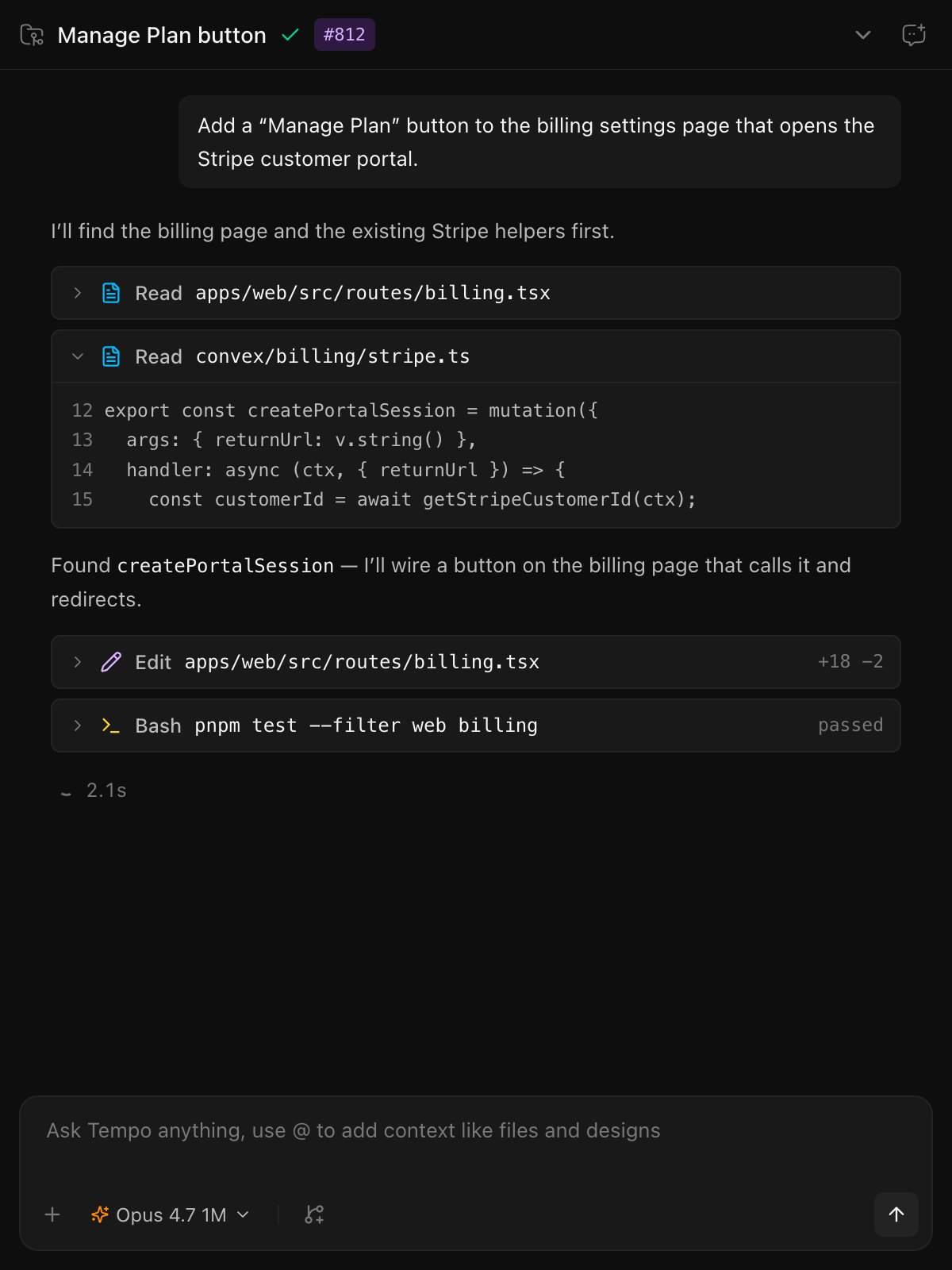
The **Chat** tab is where you collaborate with AI agents — Claude (Anthropic) or Codex (OpenAI) — inside Tempo. Every session runs in its own **git worktree**, an isolated copy of your repo on a throwaway branch, so the agent can make destructive changes without ever touching your main working tree.
Open the chat panel from the **Chat** icon in the left sidebar, or use `Cmd/Ctrl+L` from anywhere.
 ## Worktrees: isolation by default
When you start a new chat, Tempo creates a fresh worktree on a throwaway branch. The agent works in that copy. Your main branch stays untouched until you explicitly merge.
* **Happy with the work?** Use the share/merge controls at the top of the chat to bring the changes back into your main branch (or open a PR).
* **Not happy?** Discard the worktree and nothing is lost. Your main branch never saw the changes.
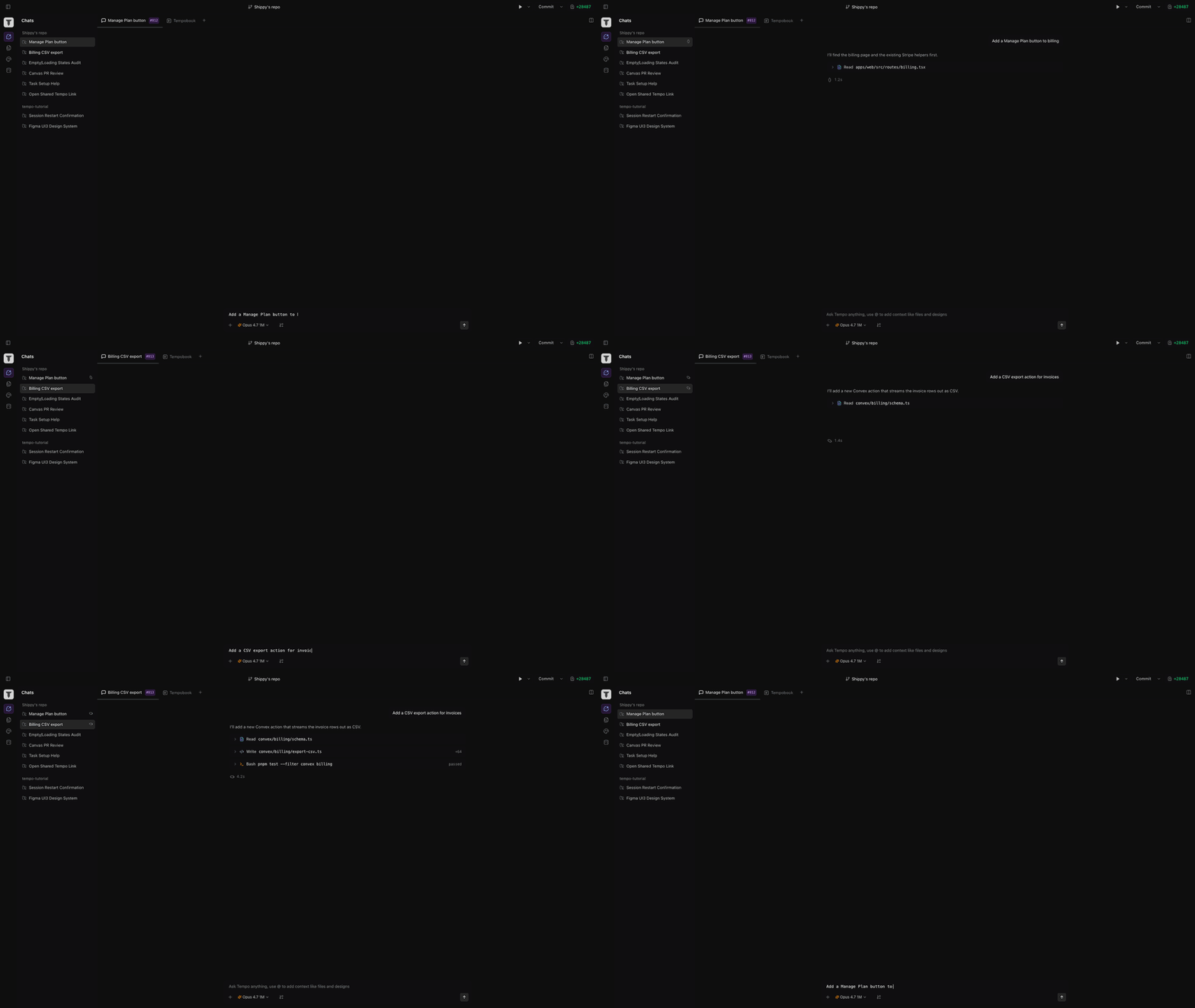
This means you can run **multiple agents in parallel** on the same repo — one per worktree — without conflicts.
## Worktrees: isolation by default
When you start a new chat, Tempo creates a fresh worktree on a throwaway branch. The agent works in that copy. Your main branch stays untouched until you explicitly merge.
* **Happy with the work?** Use the share/merge controls at the top of the chat to bring the changes back into your main branch (or open a PR).
* **Not happy?** Discard the worktree and nothing is lost. Your main branch never saw the changes.
This means you can run **multiple agents in parallel** on the same repo — one per worktree — without conflicts.
 ## Models
Pick a model from the dropdown at the bottom of the chat:
* **Claude** (Opus, Sonnet, Haiku) — sign in via `claude /login` in the terminal.
* **Codex** (GPT-5.4 Codex, GPT-5.4-mini) — sign in via `codex login`.
See the [Quick Start](/guides/quick-start#3-connect-codex-or-claude) for sign-in details.
## Context the agent sees
Every turn, the agent automatically has access to:
* The current worktree (full file tree, git history).
* Any [docs](/product/docs) you've linked to the session.
* Any [canvases](/product/canvas) you've linked to the session.
* Any [issues](/product/issues) you've linked to the session.
This is the unified context layer — instead of pasting requirements into the prompt, you link the PRD and the agent reads it.
## Plan mode
Before letting the agent execute, you can ask it to produce a plan: a structured proposal of what it intends to change. Review and edit before approving. The agent only writes files once you accept the plan.
## Models
Pick a model from the dropdown at the bottom of the chat:
* **Claude** (Opus, Sonnet, Haiku) — sign in via `claude /login` in the terminal.
* **Codex** (GPT-5.4 Codex, GPT-5.4-mini) — sign in via `codex login`.
See the [Quick Start](/guides/quick-start#3-connect-codex-or-claude) for sign-in details.
## Context the agent sees
Every turn, the agent automatically has access to:
* The current worktree (full file tree, git history).
* Any [docs](/product/docs) you've linked to the session.
* Any [canvases](/product/canvas) you've linked to the session.
* Any [issues](/product/issues) you've linked to the session.
This is the unified context layer — instead of pasting requirements into the prompt, you link the PRD and the agent reads it.
## Plan mode
Before letting the agent execute, you can ask it to produce a plan: a structured proposal of what it intends to change. Review and edit before approving. The agent only writes files once you accept the plan.